
Do you only have one day in Palermo or a few hours' layover to visit the Sicilian capital on foot? Well, I propose an optimized itinerary to visit Palermo in one day or a few hours.
And to make sure you don't get lost, I've included below the route which can be downloaded for free on Google Maps to guide you step by step!
Thus, in one day, you can explore the essentials of Palermo, its authentic atmosphere and its abundant heritage.


Is it possible to visit Palermo in one day?
Palermo has been shaped by centuries of diverse influences: Arab, Norman, Byzantine, Spanish. This is reflected in its architecture, cuisine, and culture.
Just like for Florence or Naples , one day is enough to discover the must-sees of the historic center of Palermo, a UNESCO World Heritage Site.
Therefore, this itinerary focuses on the heart of the old town, which is easily explorable on foot.
Walking tour to visit Palermo
Before detailing my itinerary, you can first download the Google Maps of the walking tour to follow in Palermo: https://maps.app.goo.gl/ftW5qGdd34TLwKnd6
One-day walking tour itinerary of Palermo
- My circuit starts from the Independence Square in front of Palace of the Normans, an Arab-Norman masterpiece. You will be able to visit the magnificent Palatine ChapelA jewel of golden mosaics and precious marquetry that has survived the centuries. Remember to book in advance as the site is busy in the morning.
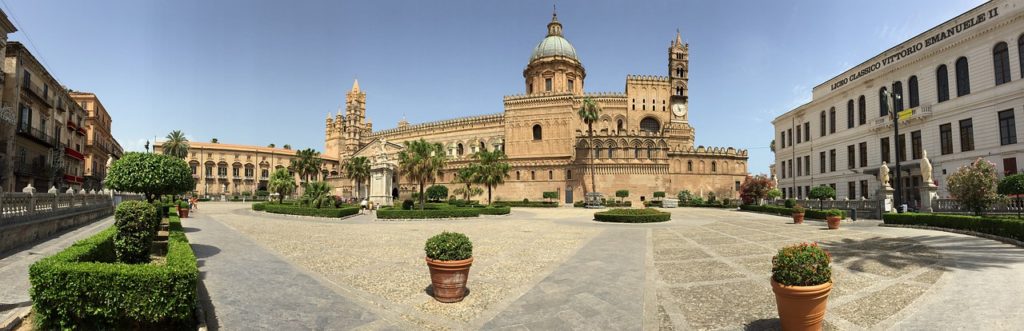
- Next, walk back up Via Vittorio Emanuele to reach the Palermo CathedralIt is striking for its fusion of styles (Arab-Norman, Gothic, Baroque). Don't hesitate to explore its interior and climb to the rooftops to admire the view over the city.
- By continuing straight ahead, you will arrive at the famous Quattro Canti, baroque crossroads and “navel of the city”, adorned with statues and fountains which form one of the most photographed settings in Palermo.
- Go down a few steps to the Piazza Pretoria where the monumental Pretoria Fountainsurrounded by enigmatic statues and the town hall. Nicknamed the "Fountain of Shame" by the locals because of the nudity of its statues.
- Continue on foot towards the Piazza Bellini Right next door, you can admire two major churches:
- Saint Catherine of Alexandria and its baroque decoration (possibility of going up onto the roofs for the view).
- San Cataldo et The Martorana and these jewels of Arab-Norman and Byzantine art with amazing domes and mosaics.
- Now take a walk through the narrow streets of the historic center Immerse yourself in the atmosphere of the old town, with its slightly crumbling palaces, laundry hanging from windows, and bustling markets. If you enjoy Sicilian cuisine, head to the Ballarò market ou Vucciria to sample local specialties.
- Continue your walk via Via Vittorio Emanuele or Via Maqueda to reach the amazing church of San Giovanni degli Eremitifamous for its red domes of Arabic inspiration and its garden.
- The walking tour ends with an unusual visit: The Capuchin CatacombsIt is an impressive necropolis where mummies from several eras rest, an experience rich in emotion.
- Or (if you prefer a more traditional option), end your day by joining the Massimo Vittorio Emanuele Theater, the largest opera house in Italy and the third largest in Europe.
Optimized itinerary for a stopover in Palermo
If you only have a few hours to explore Palermo, I recommend choosing the tourist bus option.
But if you wish to discover Palermo on foot, then this itinerary is suitable for a visit to the city in a few hours from the cruise ship arrival port:
- From the port, the easiest way is to take a taxi to the Independence SquareThis is the starting point of your tour. This will save you valuable time.
- Start by visiting the Palatine Chapel which is absolutely unmissable with its golden mosaics. Book your tickets online in advance To avoid queues, especially in the morning, as time is limited during layovers, allow approximately 1 to 1.5 hours for the visit.
- Then walk up Via Vittorio Emanuele (approximately 10-15 minutes) to the CathedralAllow 30-45 minutes for the visit.
- Continue straight along Via Vittorio Emanuele and you will arrive at the famous Quattro CantiIt's a magnificent landmark for a few quick photos.
- Go down a few steps to the Piazza Pretoria and its monumental Pretoria Fountainnicknamed the "Fountain of Shame".
- Right next door, the Piazza Bellini It comprises three jewels: Saint Catherine of Alexandria, San Cataldo (with its red domes) and The Martorana (magnificent mosaics). Choose one or two to visit quickly, depending on your preferences and available time. La Martorana is often cited as the most impressive.
- Immerse yourself in the local atmosphere by taking a quick stroll through the narrow streets of the historic center.
- If you still have some time and want to try the local specialties, head straight to the Vucciria marketThis offers the opportunity for a quick bite (Sicilian street food). Allow an extra 30 minutes if you decide to stay longer.
- Return to port Return to the cruise terminal on foot or by taxi. Allow plenty of time for the return journey!
Must-see sights in a day in Palermo
To learn more about the sights to see along my walking route, here is the historical information for each stop:
Norman Palace and Palatine Chapel
My route begins in Piazza Indipendenza in front of the Norman Palace . This architectural masterpiece is a remarkable example of the fusion of Arab-Norman and Byzantine cultures in Palermo. Originally a fortress built by the Arabs in the 9th century, it was transformed into a royal residence by the Normans in the 11th century.
Inside, the Palatine Chapel is a true gem, completed in 1143 during the reign of Roger II. Its walls are covered with golden Byzantine mosaics, depicting biblical scenes and episodes from the life of Christ, while the wooden muqarnas ceiling (a form of Islamic architecture) is a marvel of Islamic art.
Cathedral of Santa Vergine Maria Assunta
Walking up Via Vittorio Emanuele, you will reach Palermo Cathedral . This building is an architectural palimpsest, bearing witness to the city's tumultuous history. Originally built in 1185, it has undergone numerous transformations over the centuries, incorporating Arab-Norman, Gothic, Renaissance, and Baroque elements. Its exterior is particularly striking, with its domes, towers, and decorative arches. The interior houses the royal tombs of Norman and Swabian rulers, including Frederick II.
Four Corners (Vigliena Square)
Continuing straight along Via Vittorio Emanuele, you will arrive at the famous Quattro Canti , officially Piazza Vigliena. This octagonal Baroque intersection, built in the early 17th century, is a veritable open-air architectural theater. Each façade is adorned with fountains symbolizing the four seasons, statues of the Spanish kings of Sicily, and the patron saints of Palermo's four historic districts. It is nicknamed the "navel of the city" and is one of Palermo's most photographed settings, offering a unique perspective on the Baroque urban fabric.
Piazza Pretoria and Fontana Pretoria
Just steps from the Quattro Canti, Piazza Pretoria is home to the monumental Pretoria Fountain . This sculptural work by Francesco Camilliani, originally intended for a Florentine villa, was purchased by the city of Palermo in 1573 and rebuilt here. Composed of numerous statues of mythological deities, fantastical animals, and allegorical figures, its nudity earned the fountain the nickname "Fountain of Shame" among locals. It is surrounded by the Palazzo Pretorio (town hall) and other religious buildings.
Santa Caterina d'Alessandria, San Cataldo and Martorana
As you head towards Piazza Bellini , you will discover a concentration of Palermitan history and art.
- Church of Santa Caterina of Alessandria This Baroque church, attached to a former Dominican monastery, is a magnificent example of Sicilian Baroque art. Its construction spanned several centuries, from the 16th to the 18th, and its interior is richly decorated with polychrome marble, frescoes, and stucco work. It is often possible to climb onto the rooftops for a panoramic view of the domes and rooftops of Palermo.
- Church of San Cataldo Remarkable for its three red domes characteristic of Arab-Norman architecture, this 12th-century church, built by Maione da Bari, is strikingly simple compared to Baroque splendor. It is a preserved example of Islamic architecture in Sicily, with a visible Byzantine influence in its structure.
- Santa Maria dell'Ammiraglio (La Martorana) Also dating from the 12th century, La Martorana is another jewel of Arab-Norman and Byzantine art. Founded by George of Antioch, admiral to Roger II, it is famous for its magnificent 12th-century Byzantine mosaics, among the best preserved in Palermo, and for its Norman bell tower. The architectural and decorative styles reflect the cultural fusion of the period.
Historic center and Ballarò and Vucciria markets
Immerse yourself in the soul of the old town by strolling through the narrow streets of the historic center . Here, history comes alive, with its sometimes crumbling palaces that bear witness to a bygone grandeur, its laundry drying in the windows, and the lively atmosphere of everyday life in Palermo. It's an immersion in a unique atmosphere, where every street corner tells a story.
For a sensory and gustatory experience, head to the Ballarò Market or the Vucciria Market . These historic markets are much more than just places of commerce; they are the nerve centers of local life, where the cries of vendors mingle with the aromas of spices, fresh fruit, and Sicilian specialties. Ballarò, the larger and older of the two, dates back to the Arab period, while Vucciria, although less bustling than it once was, retains its historic charm and seafood stalls.
Church of San Giovanni degli Eremiti
Continue your walk along Via Vittorio Emanuele or Via Maqueda to reach the stunning Church of San Giovanni degli Eremiti . Founded in the 12th century by Roger II, this church is famous for its five red, Moorish-inspired domes, which stand out against the blue Palermo sky. Its exterior, with its simple forms and distinctive domes, is a striking example of Islamic architecture in Sicily. The church is surrounded by a beautiful, lush garden with the remains of a cloister, offering a peaceful and verdant oasis in the heart of the city.
Option 1: Capuchin Catacombs
Your walking tour can end with an unusual and unique visit: the Capuchin Catacombs . This impressive necropolis, carved beneath the Capuchin monastery, served as a burial ground from the 16th century onwards. Approximately 8000 bodies, naturally mummified or embalmed, are displayed in niches, sometimes wearing their original clothing. It's a unique and macabre experience, but also a fascinating glimpse into the funerary customs and lives of Palermitans in centuries past. The sight of these mummies—monks, nobles, young girls, and children—is both unsettling and deeply moving.
Option 2: Teatro Massimo Vittorio Emanuele
If you prefer a more traditional and cultural end to your day, head to the Teatro Massimo Vittorio Emanuele . Inaugurated in 1897, it is the largest opera house in Italy and the third largest in Europe. Designed in a neoclassical style, its imposing façade and sumptuous interiors are an ode to the art of opera. Beyond its architectural beauty, the theater has a rich history, having hosted the greatest artists of its time. Guided tours are often available, allowing you to admire its grand lobby, the main auditorium, and discover the backstage areas of this iconic Palermo cultural landmark.
Where to stay to visit Palermo on foot?
To visit Palermo on foot, it is best to stay in the historic centre or in the immediate vicinity.
The 3 neighborhoods to prioritize:
- La Kalsa / Piazza Marina / Via Maqueda (around Quattro Canti)
- Albergheria (around the Norman Palace and Ballarò)
- Castellammare (around the port and Vucciria)
Among the best-located hotels for visiting Palermo on foot, here are my two recommendations:
- Ad Hoc Rooms Located in the heart of the historic center, this budget accommodation is very well situated for quick access to tourist sites.
- Palazzo Natoli Boutique Hotel : In the Albergaria district, just 400 meters from the Pretoria fountain and the cathedral, its location is ideal.