
You want to stay in the capital of North Rhine-Westphalia in Germany and need information about safety in Düsseldorf.
Located on the banks of the Rhine, Düsseldorf is renowned for its art galleries, its designer boutiques, its historical and cultural heritage and its important economic and financial center.
Thus, many visitors stay there for business or tourism. But as most cities in Europe have become less safe, it is normal for visitors to wonder which neighborhoods to avoid in Düsseldorf when choosing accommodation.
This article therefore aims to find out if the city of Düsseldorf is dangerous, which neighborhoods to avoid and the best ones to stay in.
Is Düsseldorf a dangerous city?
After investigating travel forums and studying global rankings, it appears that Düsseldorf is not a dangerous city. In fact, like Munich , Düsseldorf is even listed among the most dangerous cities in the world.
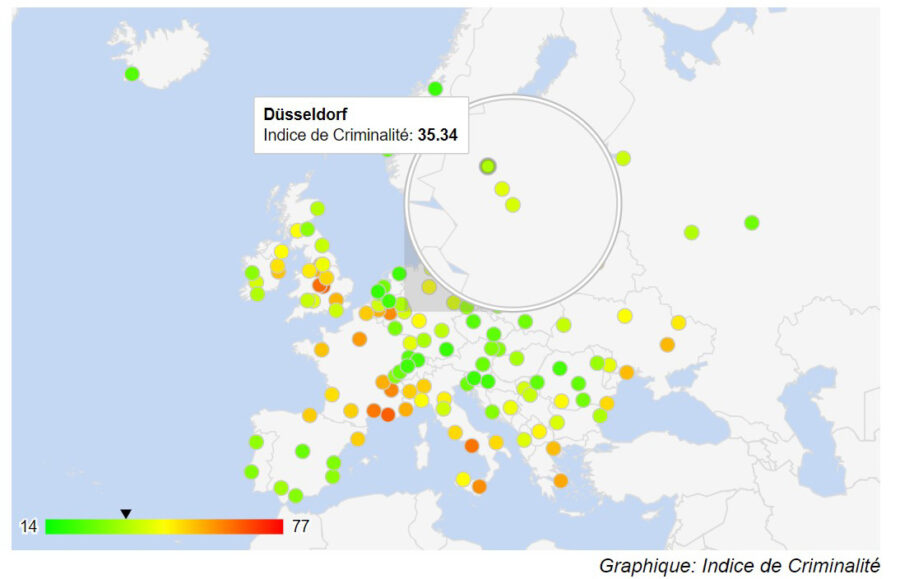
According to the Numbeo ranking , in 2024 Düsseldorf has a crime index of 35.34, which places it among the least crime-ridden European cities.
In comparison, Düsseldorf is safer than Hamburg , Berlin , Belgrade , Sofia or Strasbourg.
See on the map published on the site Numbeo.com where Düsseldorf is in light green which indicates a fairly low level of crime:
Here's another map to help you locate neighborhoods to avoid in Düsseldorf and the best areas to stay, which you'll find listed below: Google Maps
Crime on the rise in Düsseldorf
Even though Düsseldorf is not a dangerous city, its crime rate is rising – see the article " The situation regarding violent crime has worsened " or the 2023 article which mentions that Düsseldorf entered the Top 10 most dangerous cities in Germany: alianzdirect.de
Neighborhoods to avoid in Düsseldorf
To be on the safe side, tourists should avoid the following 3 areas which are the least safe to stay in:
- The Düsseldorf central station area
- The Oberbilk district just behind the station
- Niederkassel
Red light districts in Düsseldorf
Red light districts are often places to avoid at night because of their crowds and the risk of fights, thefts or attacks.
In Düsseldorf, there are two red light districts which are Flingern Süd in the east of the city (to be avoided) and the Altstadt in the center of Düsseldorf.
The Altstadt, also known as the "longest bar in the world", is also the old town of Düsseldorf and one of its most beautiful districts. This historic district is indeed lined with bars, pubs and restaurants but is not a dangerous place. However, some parts of the Altstadt are less busy at night.
Which area to stay in Düsseldorf?
Düsseldorf offers a variety of accommodation options to suit all tastes and budgets. Whether you prefer the luxury and comfort of a five-star hotel, the authenticity of the old town, or the originality of a designer hotel, you will certainly find the perfect place to stay during your visit.
Here are the 3 favorite neighborhoods of tourists who visit Düsseldorf:
Altstadt – The tourist district of Düsseldorf
The Altstadt district, also known as the Old Town, is one of Düsseldorf's most iconic landmarks. Located on the east bank of the Rhine, it's renowned for its medieval architecture and lively atmosphere. You can explore it by taking a boat trip.
As you stroll through the cobblestone streets of Altstadt, you will be transported into the city's past. Colorful half-timbered houses and historic buildings create a unique and charming ambiance. Don't miss the beautiful Marktplatz square, where you'll find the Düsseldorf City Hall, an impressive building dating from the 16th century.
Altstadt is also home to numerous museums and art galleries, perfect for culture lovers. The Kunstsammlung Nordrhein-Westfalen, for example, is a renowned contemporary art museum that houses works by renowned international artists.
The area is also famous for its breweries where you can taste local beer and traditional German dishes. Also be sure to try “Altbier”, a typical Düsseldorf amber beer.
Here is a very centrally located hotel, very close to the Altstadt (Old Town), the Stadterhebungsmonument (City Hall Monument), the town hall, and the Königsallee district with its famous Kö street: Ruby Luna Hotel Dusseldorf
Indeed, this hotel has the ideal location for a tourist stay close to the tourist attractions, bars, restaurants, shops and entertainment of Düsseldorf.
Königsallee – The luxury and shopping district of Düsseldorf
Located in the Stadtmitte district, Königsallee is one of the most famous avenues in Düsseldorf. Nicknamed “Kö” by locals, this avenue is renowned for its luxury boutiques, elegant hotels and chic cafes.
The focal point of Königsallee is its beautiful tree-lined boulevard, home to the world's leading luxury brands. Shopping enthusiasts will be delighted by the elegant windows and the latest fashion trends.
Besides luxury shopping, Königsallee also offers wonderful green spaces. The Hofgarten, a nearby public park, is a great place to relax and enjoy nature right in the heart of the city.
After a shopping trip, stop at one of Königsallee's many cafés and restaurants to enjoy a cup of coffee or a delicious pastry. The beer gardens offer a stylish and relaxed atmosphere, perfect for people-watching.
Oberkassel – Trendy and lively neighborhood
Oberkassel is a trendy and vibrant district located on the east bank of the Rhine. It is known for its vibrant nightlife, trendy restaurants and picturesque riverside promenade.
With its many bars, clubs and discos, Oberkassel is the ideal place to enjoy Düsseldorf's nightlife. The streets are lively until the wee hours of the morning, and you can dance the night away in one of the city's trendiest clubs.
During the day, stroll along the riverside promenade and enjoy the breathtaking views of the Rhine. You can also cycle or jog along this beautiful promenade, which connects Oberkassel with other parts of the city.
Oberkassel is also renowned for its varied gastronomic scene. From international restaurants to quaint cafes, you'll find it all in this trendy neighborhood. Be sure to try local specialties, such as traditional German sausages and craft beer.
This article was written with data published in 2024 on the web (press articles, statistics, studies and rankings). It is therefore a factual article which does not contain any judgment or discriminatory remarks.